3D-Compass Celestial Pointer
Your Personal Navigator to the Stars.
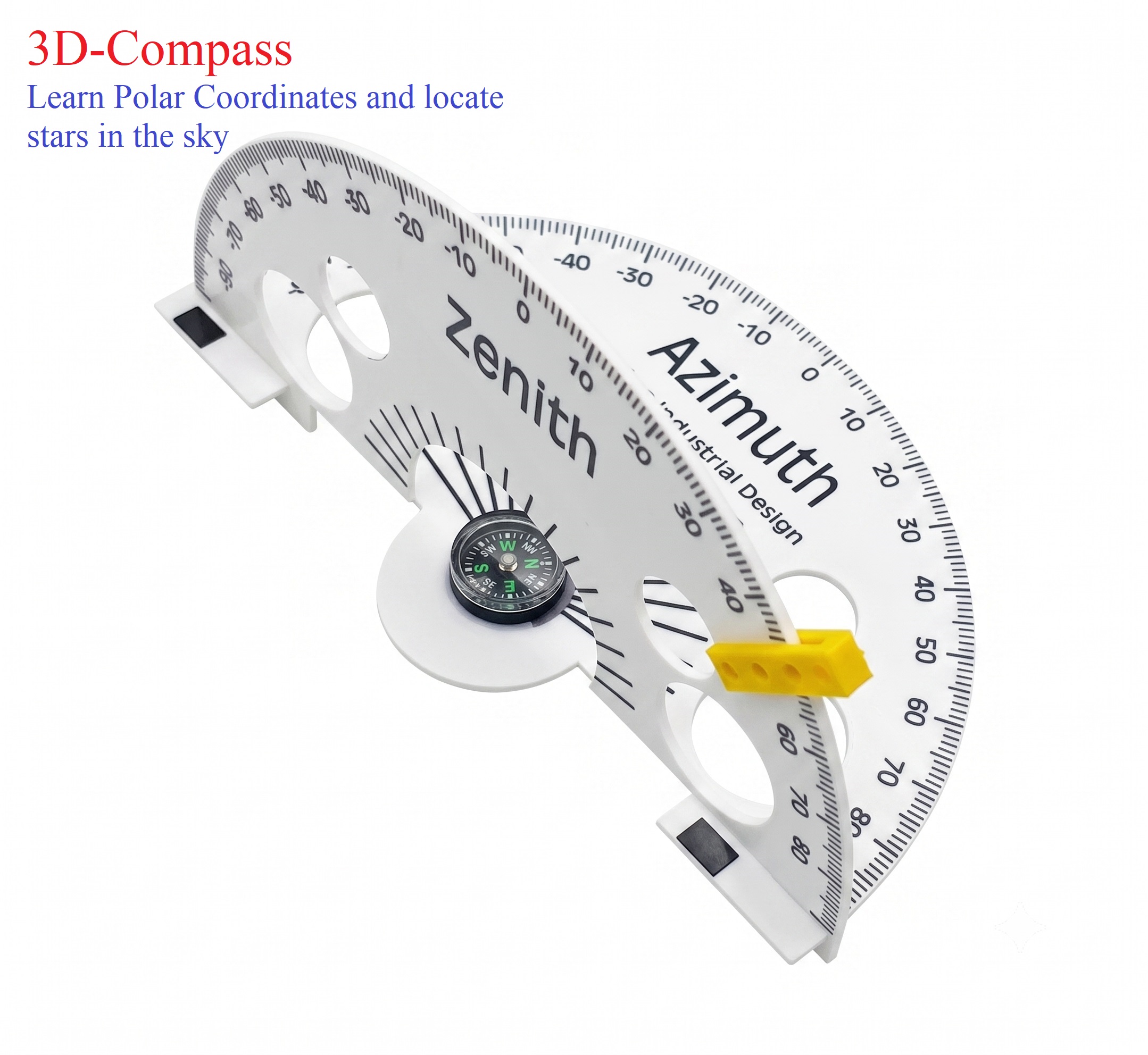
The 3D-Compass is a precision tool designed to master spherical polar coordinates and bridge the gap between astronomical data and the physical sky. By utilizing a dual-protractor spherical coordinate system, it allows you to locate any celestial object—planets, stars, or satellites—with simple manual adjustments. A precision mechanical instrument designed to master spherical polar coordinates
The Instrument
Spherical Dual-Plane Geometry
Features two semi-circular protractors graduated from -90° to +90°, permanently oriented perpendicular (90°) to each other to reproduce 3D orthogonal coordinate space.
Direct Sky-Alignment
Integrates a central magnetic compass on the horizontal plane and a low-friction yellow cursor along the vertical arc for unambiguous line-of-sight targeting.
Principles & Mapping
Calibrated along the horizon plane. Houses the central magnetic compass needle to align the instrument's reference line with terrestrial and celestial azimuth.
Positioned perpendicular to the base. Directly represents celestial declination or zenith altitude, indexed continuously from -90° through 0° to +90°.
High-contrast sliding indicator that glides smoothly over the vertical arc, providing an exact vector pointing straight toward target coordinates.
Operates seamlessly in both Equatorial Coordinates (Right Ascension & Declination) and local Horizontal Coordinates (Azimuth & Zenith Altitude).
Targeting & Procedure
Coordinate Mapping Matrix
| Plane | Range | Measurement Mode |
|---|---|---|
| Horizontal | -90° to +90° | Right Ascension / Azimuth |
| Vertical | -90° to +90° | Declination / Zenith Angle |
| Pointer | Continuous | Sliding Vector Arrow |
| Reference | 360° Magnetic | Integrated Center Compass |
1. Align the magnetic compass needle with target Right Ascension / Azimuth by rotating the tool horizontally.
2. The vertical semi-circle is now precisely locked into the star's meridian plane.
3. Slide the yellow arrow cursor to the star's Declination angle to establish the direct line of sight.