Coordinate System Board Game
An interactive, competitive classroom math game designed by Sahra Industrial Design, uniting 2D Cartesian mapping, 20-sided dice mechanics, and Pythagorean distance calculation on a dynamic 4-quadrant plane[cite: 5].
The Game Board
4-Quadrant Playing Surface
A 20 × 20 grid centered at the origin (0,0) spanning -10 to +10 along both X and Y axes, complete with geometric curves (Circle, Parabola, Ellipse, Hyperbola, and Sloped Lines)[cite: 5].
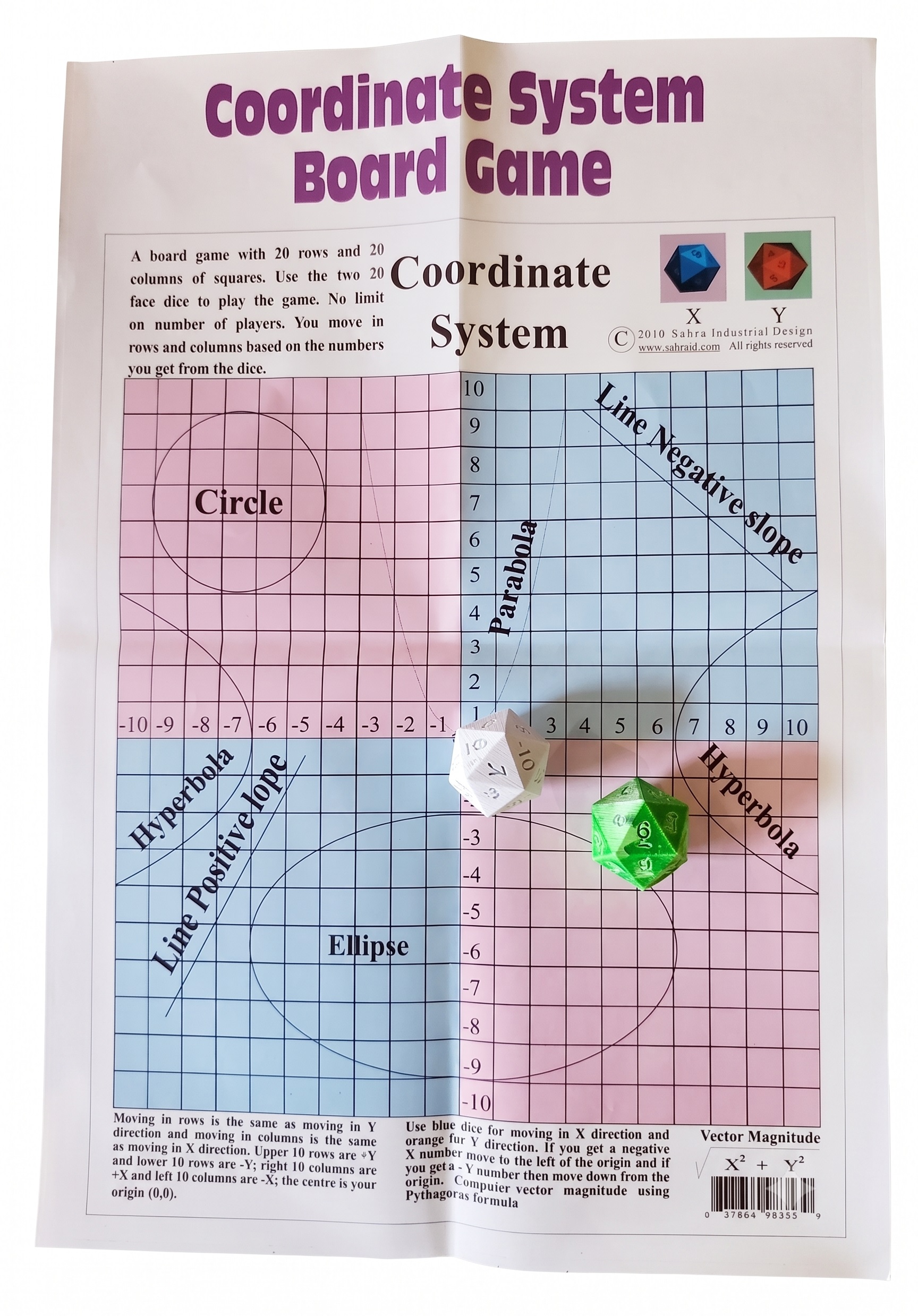
Polyhedral Coordinate Generation
Includes two 20-face polyhedral dice (color-coded for X and Y components) to roll random integer coordinates spanning positive and negative quadrants[cite: 5].
Game Mechanics
Roll both 20-sided dice simultaneously: one die dictates horizontal X coordinate displacement, while the other sets vertical Y coordinate displacement[cite: 5].
Move left/right along columns for ±X and up/down along rows for ±Y relative to the central (0,0) origin[cite: 5].
Plotting locations challenges players to identify whether their coordinates fall within embedded loci: Circle, Ellipse, Parabola, or Hyperbola zones[cite: 5].
Accommodates individual practice or multi-player competitive rounds with no limit on participant numbers[cite: 5].
Vector Magnitude
Coordinate Quadrant Reference
| Quadrant | X Axis | Y Axis |
|---|---|---|
| Quadrant I | Positive (+1 to +10) | Positive (+1 to +10) |
| Quadrant II | Negative (-1 to -10) | Positive (+1 to +10) |
| Quadrant III | Negative (-1 to -10) | Negative (-1 to -10) |
| Quadrant IV | Positive (+1 to +10) | Negative (-1 to -10) |
Calculate the true vector displacement (distance) from origin (0,0) to plotted coordinate (X, Y)[cite: 5]:
Reinforces Euclidean metric calculation, powers, roots, and sign cancellations on negative integers[cite: 5].