SID Sahra Industrial Design | Precision Astronomical Instruments
Documentation: Monthly Sun Position Globe

The Globe

An interactive, calibrated mechanical celestial instrument demonstrating Earth's axial inclination, seasonal variations, and shifting subsolar geometry.
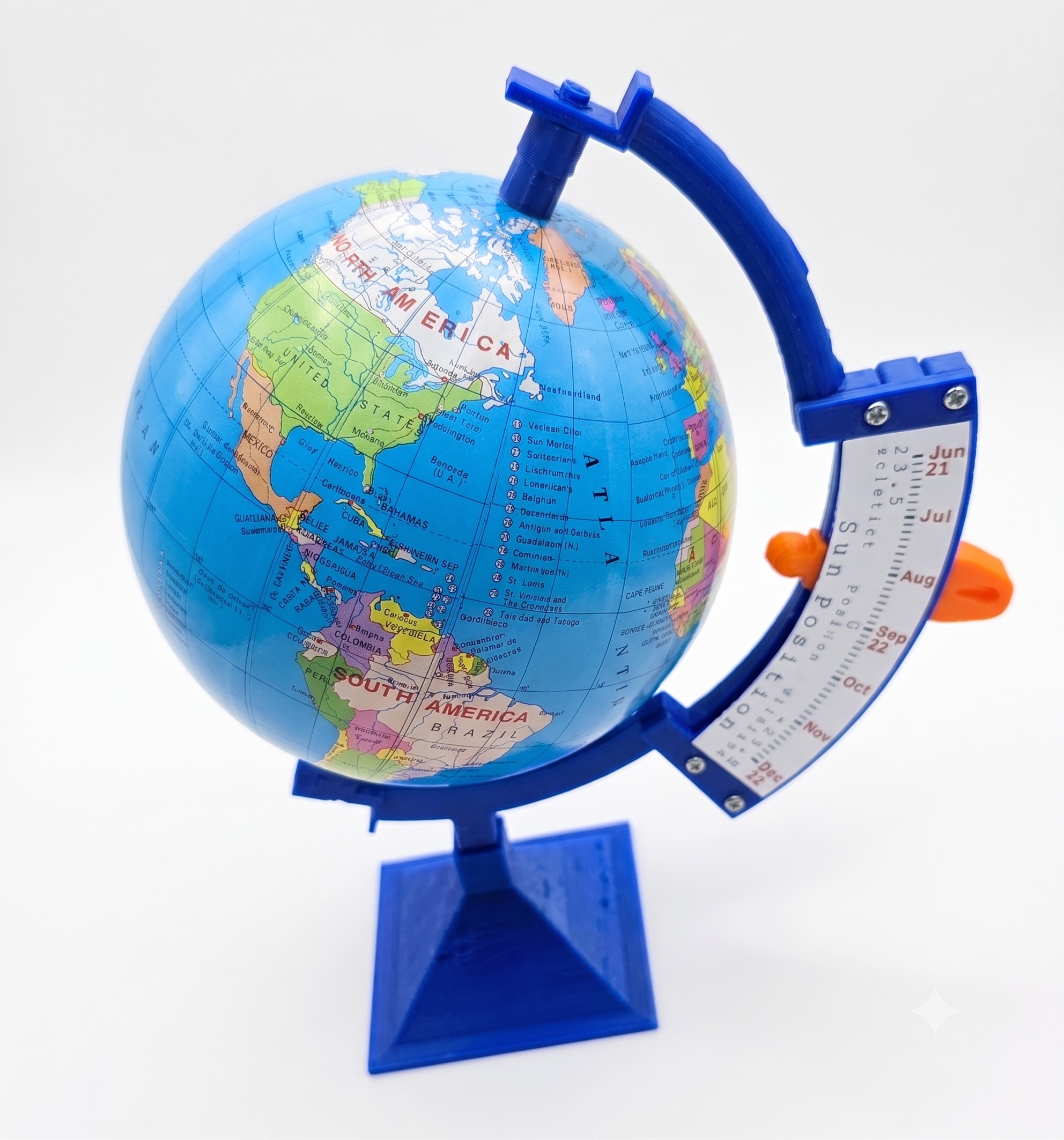
Monthly Sun Position Globe with Meridian Arch and Pointer

The Monthly Sun Position Globe

1. Fixed 23.4° Tilt Mounting

The polar axis is permanently inclined at Earth's authentic obliquity (23.4°) relative to vertical normal, preserving true spatial orientation.

2. Calibrated Meridian Arch

Indexed guide track displaying annual calendar months directly aligned with latitude degrees from +23.4° (Cancer) down to -23.4° (Capricorn).

3. Sliding Sun Pointer

Ergonomic orange cursor pointing directly to the subsolar latitude receiving perpendicular (90°) midday sun on that calendar date.

Principle I: Angle vs. Distance

Seasons are governed by incident solar angle, not distance to the Sun. Perpendicular rays (90°) concentrate heat; shallow rays disperse energy over wide areas.

Principle II: The ±23.4° Boundaries

Due to axial tilt, the subsolar point never migrates north of +23.4° (Tropic of Cancer) or south of -23.4° (Tropic of Capricorn).

Demonstrations & Care

Solar Cycle Benchmarks

Event Date Latitude
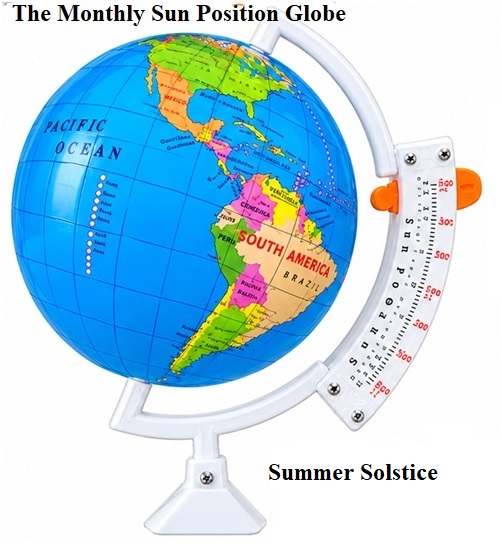
Summer Solstice June 20–21 +23.4° (Tropic of Cancer)
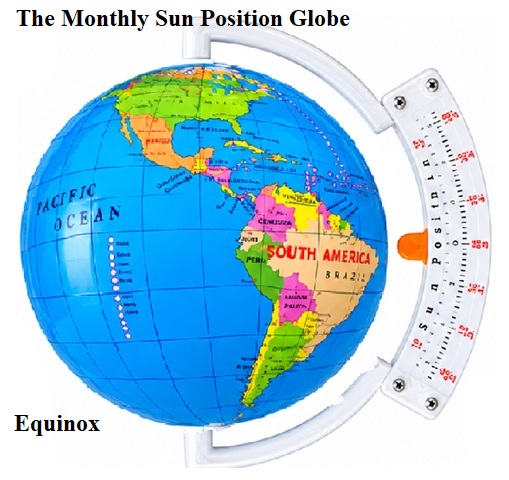
Autumnal Equinox Sept 22–23 0.0° (Equator)
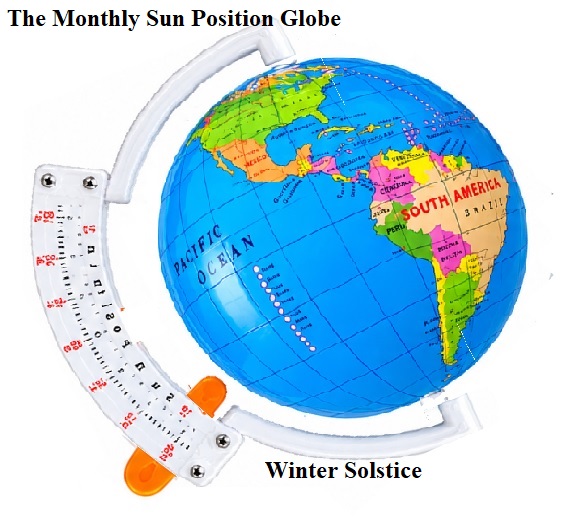
Winter Solstice Dec 21–22 -23.4° (Tropic of Capr.)
Vernal Equinox March 20–21 0.0° (Equator)
Local Solar Elevation Formula

Calculate your midday solar elevation angle for any city:
Angle = 90° - |Your Latitude - Pointer Latitude|

How Seasons Work

Monthly Sun Position Globe with Meridian Arch and Pointer
Principle I: Angle vs. Distance

Seasons are governed by incident solar angle, not distance to the Sun. Perpendicular rays (90°) concentrate heat; shallow rays disperse energy over wide areas.

Principle II: The ±23.4° Boundaries

Due to axial tilt, the subsolar point never migrates north of +23.4° (Tropic of Cancer) or south of -23.4° (Tropic of Capricorn).

Solstices

Monthly Sun Position Globe with Meridian Arch and Pointer
Simulating Solstices & Polar Night

Set the slider to June 21 (+23.4°). Spin the globe: the Arctic Circle remains in continuous 24-hr daylight (Midnight Sun), while the Antarctic remains dark.

Summer in Northern Hemispher & Winter in Southern Hemisphere

People living in the northern hemisphere feel warm as the sun shines more directly ( 0 to +23.4°) during month of Mar and Aug.

Equinox

Monthly Sun Position Globe with Meridian Arch and Pointer
Simulating Equinox Balance

Set the slider to September 22 (0°). Spin the globe: both poles touch the day/night boundary equally, yielding 12 hours of day and night worldwide.

Winter in Northern Hemispher & Summer in Southern Hemisphere

People living in the southern hemisphere feel warm as the sun shines more directly ( 0 to -23.4°) during month of Sep and Feb.